09/26/26

Definitions of mathematics

Some my friends on FB started to discuss the nature and definition of Mathematics.

I do not know a satisfactory definition of mathematics but I am happy to share my small collection of descriptions of mathematics (prepared a few years ago for Quora); some of them sound as attempts to define mathematics.

I. Mathematics is an exact language for description, calculation, deduction, modelling, and prediction — more a systematic way of thinking than a set of rules.

II. Using a legal analogy, mathematics is a language for writing contracts with Nature that Nature accepts as legally binding.

III. The practical importance of mathematics lies in its ability to describe the real world.

The real world consists of what matters. The word “matter” as a noun is used for what the physical world is made of. But if we ask, “What’s the matter with Anne?” we may be asking about a physical ailment, or we may be asking about an idea that is causing Anne to behave strangely. Ideas matter.

The whole point of mathematical education is to make ideas real for students, ideas that were not real for them before. Ideas like fractions, for example. The fact that 2/3 is smaller than 3/4 matters in the real world.

IV. Mathematically educated people are stem cells of a technologically advanced society. Because of the universality of mathematics, mathematicians and well educated users of mathematics are flexible in applying and inventing tools for work in technological environments which never existed before.

V. Learning mathematics involves the profound assimilation of intellectual and aesthetic criteria as well as practically orientated ones. The very difficulty in learning mathematics makes it a personality-enhancing experience.

[The above are borrowings from David Corfield, Tony Gardiner, Michael Gromov, Frank Quinn, David Pierce — I do not remember now in which order.]

VI. Mathematics is a part of physics. Physics is an experimental science, a part of natural science. Mathematics is the part of physics where experiments are cheap. — Vladimir Arnold

VII. Mathematics is the music of reason. — James Joseph Sylvester

VIII. Mathematics: solving tomorrow’s problems yesterday. — Rob Wilson

IХ. Mathematics is the study of mental objects with reproducible properties. — Philip J Davis and Reuben Hersh

X. Finally, my own extension of the thesis by Davis and Hersh:

Mathematics is the study of mental constructs with reproducible properties which imitate the causality structures of the physical universe аnd are expressed in the human language which evolved for social interactions.

09/15/26

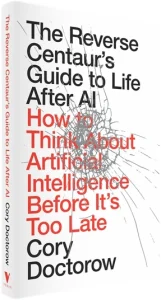
Doctorow: The Reverse Centaur’s Guide to Life After AI

A centaur is a legendary creature from Greek Mythology that has the head, arms, and torso of a human and the body and legs of a horse. The word is often used as a metaphorical term for any kind of a human rider: on horseback, on a bike, etc. Cory Doctorow coined the expression ‘reverse centaur’ for a human being conscripted as the assistant to a dominant machine – for example, a Uber driver, I will add a few words on that at the end of this post.

On Fri 11 September I attended a presentation of Doctorow’s book The Reverse Centaur’s Guide to Life After AI: How to Think About Artificial Intelligence Before It’s Too Late, Verso Books, ISBN-13 978-1836745525, at the House of Books & Friends  in Manchester.

It was a fantastic experience. To start with, the venue was quite symbolic: a marvel of Victorian architecture (1871, designed in the Venetian Gothic style), the building of the former Reform Club, the meeting point of the  city’s Liberal elite of the late 19th century: industrialists, politicians, writers, etc. The ground floor is now occupied by a leftist book shop with a small lecture hall for about 100-150 people (where the event was taking place). Manchester prides itself as being the birthplace of political Liberalism and the Free Trade movement. Andy Burnham, the recent Mayor of Manchester and now the Prime Minister of the UK, calls his own ideology Manchesterism. Not far from the Reform Club is something which was just set up by Andy and instantly got the moniker `Number 10 North,’ by analogy with 10 Downing Street: the second seat of the UK Government, for a better connection with the North of the country. Number 10 North is a boring office building. Its ground floor is taken by a second rate chain pub Slug and Lettuce. This looks hilarious.

Cory Doctorow’s talk was entirely about socio-economic issues. At the very beginning he said “Here in Manchester there is no need to remind you about the social consequences of automatisation of production”, which was met by the audience with a warm approval. Occasionally I felt that everything looked as if it was Friedrich Engels presenting his book `The Condition of the Working Class in England’ (famously written in Manchester and about Manchester).

Decades of lecturing to large audiences (up to 400 students) developed in me a habit of quickly scanning the crowd and assessing the numbers of people present who exhibited   a particular body language or facial expression, say boredom / enthusiasm / rage (I call that `differential feedback‘).  So on return home I was able to tell my wife that half of the audience behaved and reacted as if they were Marxists; Anna responded “And you, with your short white beard, was an obvious old Trotskyist.”

The book is a breath of fresh air. Strongly recommend.

Now a promised story of reverse centaurs driving Uber cars.

Preprint of my paper Calling a spade a spade: Mathematics in the new pattern of division of labour  appeared on arXiv.org in 2014 (in 2016, it was published by Springer). This was the reason why in 2015 I was invited to an event in Brussels titled  From Uber to Amazon Mechanical Turk: Non-traditional labour markets driven by technological and organisational change run by a think tank of the European Commission.

It was mostly about gig economy but one day was devoted to Uber which just started its aggressive expansion in Europe, in particular, in Brussels, where local taxi drivers were unhappy to get a much cheaper competitor and were threatening the city authorities with strikes and civil unrest. There were some issues within local politics as well.  The EC was unable to interfere: at the meeting, I learnt with some astonishment, that EU had no shared labour legislation – in some countries, drivers were employees of Uber, in other – independent contractors. The aim of the event was to somehow  analyse this mess.

My contribution to the analysis  the Uber situation was modest, but worth mentioning. I explained that the two tasks, most difficult and critically important for a taxi driver, were almost completely removed from Uber drivers: (a) finding a way from A to B in a big city, and  (b) communication with clients / passengers. A driver just turned the steering wheel on instructions from a computer. A person without  knowledge of the city and unable to understand local languages could be a Uber driver. At that time, the words ‘reverse centaur’ still were not in circulation – otherwise I would be happy to use them. Anyway, an observation that a new technology could lead to a radical change in the cognitive nature of a particular profession (without eliminating it) appeared to be quite new for participants of the event (they were mostly economists and sociologists).

09/14/26

Why is linear algebra so tedious?

A new paper on my Journal:

A. Borovik,  Why is linear algebra so tedious?  Selected Passages from Correspondence with Friends 14 no. 3 (2026), 15-16.

Abstract

This is a basic law of economics of mathematics education: everything can be taught better, and without boredom, and mathematicians know how to do that — but it is more expensive.

This short note illustrates this principle using linear algebra as an example.

09/13/26

Yin and Yang of elementary geometry

A new paper on my Journal:

A. Borovik, Yin and Yang of elementary geometry,  Selected Passages from Correspondence with Friends 14 no. 2 (2026), 5-13.

Abstract:

Triangles and many other geometric figures in the plane could be chiral, not superimposable on their mirror symmetry images. This paper is a sketch of a rigorous treatment of the concepts of chirality and orientation which could be used in more deep or advanced streams of school level mathematics. It is based on treating the Euclidean plane as

A 2-dimensional real vector space with two non-degenerate bilinear forms on it, one symmetric and positive definite and another -antisymmetric (symplectic).

These two bilinear forms are the eponymous Yin and Yang of the title of the paper.

Most proofs are omitted – they are fairly obvious. The paper contains some historic comments and my personal stories, quite relevant to this topic.

09/13/26

Expertise and Incompetence

A new paper on my Journal:

A. Borovik, Expertise and Incompetence.  Selected Passages from Correspondence with Friends 14 no. 1 (2026), 1-4.

Abstract:

I comment on a thesis which belongs to the tradition set in the famous book  Anti-Intellectualism in American Life (1963) by American historian and politolog Richard Hofstadter (1916–1970):

`The complexity of modern life makes it difficult for ordinary citizens to participate independently and meaningfully in the governance of society, which undermines trust in democratic institutions.’

and argue that it is outdated: the damning formulation now applies equally to politicians—as well as to all kinds of administrators, managers in softer lines of business (where rigorous criteria, based on principles of physics and exact sciences are absent), and the like—amidst what amounts to a pandemic of incompetence.

I call on all my colleagues in exact sciences and rigorous engineering and medical disciplines: mathematicians, computer scientists, physicists, chemists, biologists, medical practitioners, engineers, …, everyone who know that they deal with the objective reality, and have sufficiently clear and efficient criteria to distinguish between true and false, probable and improbable, possible and impossible –to be more politically active, and try to infuse a bit of rationality and common sense into the current brain-dead political discourse and practice.

Who else in this world retains this endangered skill — to think rationally?


08/11/26

Expertise and incompetence

11 August 2026

A friend sent me a Telegram post, based on remarkable quotes from the famous book Anti-Intellectualism in American Life (1963) by American historian and politolog Richard Hofstadter (1916-1970). I give these quotes in full:

“But in our time, of course, American society has grown greatly in complexity and in involvement with the rest of the world. In most areas of life a formal training has become a prerequisite to success. At the same time, the complexity of modern life has steadily whittled away the functions the ordinary citizen can intelligently and comprehendingly perform for himself.

“In the original American populistic dream, the omnicompetence of the common man was fundamental and indispensable. It was believed that he could, without much special preparation, pursue the professions and run the government. Today he knows that he cannot even make his breakfast without using devices, more or less mysterious to him, which expertise has put at his disposal; and when he sits down to breakfast and looks at his morning newspaper, he reads about a whole range of vital and intricate issues and acknowledges, if he is candid with himself, that he has not acquired competence to judge most of them.

“In the practical world of affairs, then, trained intelligence has come to be recognized as a force of overwhelming importance. What used to be a jocular and usually benign ridicule of intellect and formal training has turned into a malign resentment of the intellectual in his capacity as expert. The old idea of the woolly-minded intellectual, so aptly caught in the stereotype of the absent-minded professor, still survives, of course; but today it is increasingly a wishful and rather wistful defense against a deep and important fear. Once the intellectual was gently ridiculed because he was not needed; now he is fiercely resented because he is needed too much. He has become all too practical, all too effective. He is the object of resentment because of an improvement, not a decline, in his fortunes. It is not his abstractness, futility, or helplessness that makes him prominent enough to inspire virulent attacks, but his achievements, his influence, his real comfort and imagined luxury, as well as the dependence of the community upon his skills. Intellect is resented as a form of power or privilege.” 

One more statement in that Telegram post is also attributed to Richard Hofstadter:

‘The complexity of modern life makes it difficult for ordinary citizens to participate independently and meaningfully in the governance of society, which undermines trust in democratic institutions.’

I was unable to locate it in Hofstadter’s book, where previous quotes could be found on page 34. It seems that this formulation comes from another source mentioned in the Telegram post, the paper

Tom Nichols, How America Lost Faith in Expertise And Why That’s a Giant Problem. Foreign Affaires, February 13, 2017,

where similar sentiments are attributed to a paper of 2015 (much closer to our times) by Ilya Somin – unfortunately, I was unable to trace it.

But I highlighted the words “the complexity of modern life makes it difficult for ordinary citizens to participate independently and meaningfully in the governance of society” for a good reason: I am convinced that they are already outdated.

Times have changed; the damning formulation now applies equally to politicians—as well as to all kinds of administrators, managers in softer lines of business (where rigorous criteria, based on principles of physics and exact sciences are absent), and the like—amidst what amounts to a pandemic of incompetence.

One reason for that is the ever growing chasm between people and the technology they depend on in their everyday life; it is much deeper than in 2025 and even more so—than it was in 1963. Another is the explosion in the complexity of economic, financial systems, politics of the world. And the utter inadequacy of education: it abandoned any attempts to teach anything complex.

Perhaps the worst consequence of this transformation—and it triggers a positive feedback loop—is that criteria for hiring or promoting subordinates based on competence have vanished, simply because the very understanding of what competence entails has been lost.

What remains, however, is a universal and timeless selection criterion: personal loyalty. I can see that in every country experienced by me at an above-tourism level.

Next, the loss of criteria of competence breeds various fads like wokerism, DEI (Diversity, Equity and Inclusion), Net Zero policy, etc.—they increasingly look like quasi-religious cults where understanding is replaced by blind beliefs.

A colorful example: as it was reported around 30 June 2026 in every leading British newspaper,

The Treasury [the key department of the UK Government] removed numerical reasoning tests from its graduate recruitment scheme after finding they had an “adverse impact” on candidate diversity.

Finally, a pandemic of incompetence suppresses a natural, as one would expect, immune response to uncontrollable spread of AI. This happens in the society as a whole—but, it seems, even more so in the ruling classes which have lost the understanding of what does it mean to lead, to rule.

Moreover, “the complexity of modern life makes it difficult for ordinary citizens” even to ask questions about policies, about the economy, and, more generally – about the state of the nation and its strategic standing. And here we encounter another dangerous trend: erosion of the right to ask questions and creeping totalitarianism.

The right to ask questions

One of the characteristic features of totalitarian regimes is that loyal followers are not supposed to ask questions but have to wait for answers and directives from Big Brother, Fuehrer, Leader, President etc. Moreover, asking questions openly and in public could be seen as disloyalty and a thought crime.

The right to ask questions is a fundamental right of people in a democratic nation, so obvious that it is never mentioned and becomes visible only in comparison with non-democracies.

I grew up and lived under a classical totalitarian regime and instantly see the difference. When I naturalised as a British citizen three decades ago, I was confident that I was joining a true democracy.

Unfortunately I am witnessing an increasing suppression of the right to ask questions. Here are two examples of them which are apparently seen as inappropriate, divisive — in short, undesirable:

  • In the case of Henry Nowak, did the alleged ideological indoctrination of police affect the tragic outcome of the knife attack on him?
  • Is the pursuit of Net Zero a contributing factor to the miserable state of the British economy and the loss of the energy independence of the country?

Please notice: these are just questions, they do not pre-empt answers.

They are passed to me by friends who have personal reasons to ask, but are afraid to raise the issues in public. One works in a university and has been subjected to what he describes as “ideological brainwashing.” The other works in the energy sector.

But one’s reasons for asking should not really matter. In principle, the right to ask questions should not depend on the strength of their justification.

Of course, there are natural common sense limitations for freedom of speech, including the proverbial shouting of “Fire!” in a crowded theatre when there is no fire. And I hasten to add that I am talking only about the socio-political sphere, not about inter-person communication on private matters.

But suppression of questions goes beyond common sense, it is the most widespread form of silent suffocation of the freedom of speech. At the level of individuals, suppression of questions is easily internalised and becomes a subconscious level inhibition not even recognised by them—especially if their skill to pin-point a problem and formulate a question is not properly developed. This is what is happening with hundreds of millions or even billions of people living under totalitarian regimes. I lived there, I had seen that.

Yesterday I heard on the TV: “It is time to ask some awkward questions.” But questions should not be pre-judged as awkward. It is answers that could be awkward indeed.

Politicians who never ask questions and instead wait for ready answers from quangos, unelected and unaccountable to the electorate — they are not fit for the role of leaders of a democratic nation.

Epilogue

I would prefer not to go in details of a current scandal in British universities which succinctly summarised in the title of one of many articles on that subject in The Telegraph (the leading right-wing British broadsheet newspaper).

The Arday scandal exposes the creeping decay of Britain’s great universities

(by Charles Moore, 08 August 2026, https://www.telegraph.co.uk/news/2026/08/08/arday-scandal-exposes-decay-britain-great-universities/).

The interested readers may wish to browse through the tidal wave of publications and see for themselves that the roots of `the creeping decay of Britain’s great universities’  are in

The loss of criteria of competence and suppression of the right to ask questions.
 

05/8/26

Is pure math hard? What type of people would study pure math?

My answer to a question on Quora:

Any mathematics is hard, not only pure mathematics, but pure mathematics is special, and is perhaps is hardest of all. I love this motto coined by my colleague Rob Wilson:

Mathematics: solving tomorrow’s problems yesterday.

Of course, it is about pure mathematics — applied mathematics solves today’s problems, and solves today. But it was pure mathematics which had ready mathematical methods for physicists when they started to develop the general relativity theory and quantum mechanics, and for cryptographers when they needed computer based methods for signing and authenticating electronic documents, including financial documents and money transactions — the very existence of the global financial system now depends on this tools based on mathematics of yesteryear.

So, what type of people would study pure math? People who love precise, concise, very abstract thinking, people who value clarity of thought. Serious study of pure mathematics means choosing a specific lifestyle: first of all, you have to love the process of thinking, deep systematic thinking with full concentration of all your attention on it. Also, you have to have a sufficiently long attention span, ability to think, and do nothing else, for long periods of time.

So, the shortest answer to your question:

People who love to think.

As a comment, I added later:

My own experience of application of mathematics was just picking from a shelf something known (in ”pure” mathematics) for some time, and known for completely different reasons. The hard part was to understand what engineers want from you, ignoring their clumsy efforts to express that mathematically, and looking at the core of the *raw* problem.

05/6/26

Keith Devlin on “The truth/weapon duality of mathematics”.

Keith Devlin kindly commented in his traditional column   on my paper  The truth/weapon duality of mathematics. Strongly recommend his post as well his previous one, How do you respond when you are asked to use your expertise to help your nation?

A quote from Devlin:

I received an email from a reader the UK (we have met, and occasionally exchange ideas) alerting me to a recently published paper by Alexandre Borovik, a retired mathematician from the University of Manchester (where I taught briefly back in the 1970s), titled The Tool/Weapon Duality of Mathematics and published in the Journal of Humanistic Mathematics, Vol 16, Issue 1, January 2026.

Some of what Borovik writes is familiar to me, but he took his own reflections on working on projects with military relevance and extended them by researching the literature. It was his paper from which I took, not only the title for this post, but also the question quotation I began with. Those words were spoken by Russian President Vladimir Putin, speaking to journalists and media executives from BRICS countries on 18 October 2024.

[Given that source, the current US government’s assault on universities and their slashing of research funds (all of which the UK government did in the 1980s when I was a casualty) seems particularly unwise. But again, we get the administration the People elect.]

I urge you to read Borovik’s paper. It’s a mere 24 pages long, plus five pages of highly useful references. It’s all highly relevant to American-based mathematicians today, some of whom will (assuming we remain a democracy and there is a change of government) undoubtedly find themselves facing a decision like the one I did back in the first decade of the 21st Century. Vladimir Putin was correct. And yes, I just wrote that. In an essay about mathematics.

I’ll end with a quotation from Borovik:

 Mathematics, as we know it, was born as a weapon of subjugation and tyrannic control.

He brings the historical receipts to back up that statement. Though I was peripherally familiar with the historical events it refers to (particularly the beginnings of arithmetic in Sumeria over five thousand years ago, which I have written about in some of my books), the starkness of his assertion made me jolt. Facts have a habit of doing that.

05/4/26

AI slop about AI

I was invited to contribute a chapter to a a Collective Volume: Artificial Intelligence and Society: Crossed Perspectives, Issues and Prospects, to be published by Springer.

On 2 March 2026 I asked Copilot Think Deeper:

“Write a paper for a Collective Volume: Artificial Intelligence and Society: Crossed Perspectives, Issues and Prospects, to be published by Springer. Prepare the manuscript in \LaTeX format using Springer’s class file”.

The result came in a few seconds, under the title Artificial Intelligence, data totality, and the reconfiguration of human agency: Societal prospects and crossed perspectives. I checked a few items in the bibliography: they look genuine, even if slightly outdated. A pdf file of the paper is available here. It is passable. But I preferred to write my own paper. I hope it does not look like an AI slop.

04/19/26

How do you intuitively explain the fact that the bidual of an infinite dimensional vector space is bigger than the vector space itself?

My answer to a question on Quora:
“How do you intuitively explain the fact that the bidual of an infinite dimensional vector space is bigger than the vector space itself?”.
MY ANSWER:
It is a very deep question indeed. I have to admit that I cannot give any intuitive explanation which is simpler than a reduction to some basic set theory.
To make the question as close to the set theory as possible, let us restrict our attention to the case of a vector space V over the field F_2 of two elements. If my memory does not betray me, it is an old result by Paul Eklof that existence of a basis in an arbitrary vector space over F_2 is equivalent to the Axiom of Choice (it is easy in one direction: the Axiom of Choice, in the form of the Zorn Lemma, implies the existence of a basis). So, let us accept it, and let B be a basis in V, which means that every vector v in V is defined by its support in B, that is, by the (finite) set of elements in B which sum up to v. Therefore V has the same cardinality as the set of finite subsets of B; if B is infinite, than it is easy to prove that the set of all finite subsets of B has the same cardinality as B, hence V has the same cardinality as B.
Now let us look at the dual space V*, that is, the set of all linear functionals from V to F_2. Each such functional is uniquely determined by its support in B, that is, by the set of basis vectors where it takes value 1. Therefore V* is in one-to-one correspondence with the set 2^B of all subsets in B. But it is a classical result by Cantor that 2^B has larger cardinality than B and hence V* has larger cardinality than V. Of course, the cardinality of the bidual V** is even larger.
The case of an arbitrary field F can be handled in a similar way, but we will need to deal with the cardinality of the set F^B.
Is this intuitive? Well, it is intuitive for me because it was the first thought that crossed my mind. But I am not a set theorists and I have no idea whether the same can be proven without the Axiom of Choice. Also, the term “infinite dimensional vector space is ambigous: does it mean “a vector space without a finite basis” or “a vector space with an infinite basis”? And can anything that intimately involves the Axiom of Choice be called intuitive?
COMMENTS: Someone commented on that: “Without Axiom of Choice, a vector space can have trivial dual (containing only the null functional).” If true (I am not a set theorist and cannot judge), this even more emphasises the crucial role of Axiom of Choice. Also, I had perhaps mention in my answer that the situation could be very different if we consider topological vector spaces and continuous linear functionals on them.