09/15/26

Doctorow: The Reverse Centaur’s Guide to Life After AI

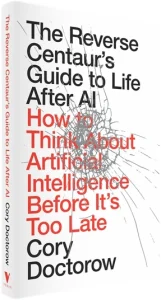
A centaur is a legendary creature from Greek Mythology that has the head, arms, and torso of a human and the body and legs of a horse. The word is often used as a metaphorical term for any kind of a human rider: on horseback, on a bike, etc. Cory Doctorow coined the expression ‘reverse centaur’ for a human being conscripted as the assistant to a dominant machine – for example, a Uber driver, I will add a few words on that at the end of this post.

On Fri 11 September I attended a presentation of Doctorow’s book The Reverse Centaur’s Guide to Life After AI: How to Think About Artificial Intelligence Before It’s Too Late, Verso Books, ISBN-13 978-1836745525, at the House of Books & Friends  in Manchester.

It was a fantastic experience. To start with, the venue was quite symbolic: a marvel of Victorian architecture (1871, designed in the Venetian Gothic style), the building of the former Reform Club, the meeting point of the  city’s Liberal elite of the late 19th century: industrialists, politicians, writers, etc. The ground floor is now occupied by a leftist book shop with a small lecture hall for about 100-15o people (where the event was taking place). Manchester prides itself as being the birthplace of political Liberalism and the Free Trade movement. Andy Burnham, the recent Mayor of Manchester and now the Prime Minister of the UK, calls his own ideology Manchesterism. Not far from the Reform Club is something which was just set up by Andy and instantly got the moniker `Number 10 North,’ by analogy with 10 Downing Street: the second seat of the UK Government, for a better connection with the North of the country. Number 10 North is a boring office building. Its ground floor is taken by a second rate chain pub Slug and Lettuce. This looks hilarious.

Cory Doctorow’s talk was entirely about socio-economic issues. At the very beginning he said “Here in Manchester there is no need to remind you about the social consequences of automatisation of production”, which was met by the audience with a warm approval. Occasionally I felt that everything looked as if it was Friedrich Engels presenting his book `The Condition of the Working Class in England’ (famously written in Manchester and about Manchester).

Decades of lecturing to large audiences (up to 400 students) developed in me a habit of quickly scanning the crowd and assessing the numbers of people present who exhibited   a particular body language or facial expression, say boredom / enthusiasm / rage (I call that `differential feedback‘).  So on return home I was able to tell my wife that half of the audience behaved and reacted as if they were Marxists; Anna responded “And you, with your short white beard, was an obvious old Trotskyist.”

The book is a breath of fresh air. Strongly recommend.

Now a promised story of reverse centaurs driving Uber cars.

Preprint of my paper Calling a spade a spade: Mathematics in the new pattern of division of labour  appeared on arXiv.org in 2014 (in 2016, it was published by Springer). This was the reason why in 2015 I was invited to an event in Brussels titled  From Uber to Amazon Mechanical Turk: Non-traditional labour markets driven by technological and organisational change run by a think tank of the European Commission.

It was mostly about gig economy but one day was devoted to Uber which just started its aggressive expansion in Europe, in particular, in Brussels, where local taxi drivers were unhappy to get a much cheaper competitor and were threatening the city authorities with strikes and civil unrest. There were some issues within local politics as well.  The EC was unable to interfere: at the meeting, I learnt with some astonishment, that EU had no shared labour legislation – in some countries, drivers were employees of Uber, in other – independent contractors. The aim of the event was to somehow  analyse this mess.

My contribution to the analysis  the Uber situation was modest, but worth mentioning. I explained that the two tasks, most difficult and critically important for a taxi driver, were almost completely removed from Uber drivers: (a) finding a way from A to B in a big city, and  (b) communication with clients / passengers. A driver just turned the steering wheel on instructions from a computer. A person without  knowledge of the city and unable to understand local languages could be a Uber driver. At that time, the words ‘reverse centaur’ still were not in circulation – otherwise I would be happy to use them. Anyway, an observation that a new technology could lead to a radical change in the cognitive nature of a particular profession (without eliminating it) appeared to be quite new for participants of the event (they were mostly economists and sociologists).

09/14/26

Why is linear algebra so tedious?

A new paper on my Journal:

A. Borovik,  Why is linear algebra so tedious?  Selected Passages from Correspondence with Friends 14 no. 3 (2026), 15-16.

Abstract

This is a basic law of economics of mathematics education: everything can be taught better, and without boredom, and mathematicians know how to do that — but it is more expensive.

This short note illustrates this principle using linear algebra as an example.

09/13/26

Yin and Yang of elementary geometry

A new paper on my Journal:

A. Borovik, Yin and Yang of elementary geometry,  Selected Passages from Correspondence with Friends 14 no. 2 (2026), 5-13.

Abstract:

Triangles and many other geometric figures in the plane could be chiral, not superimposable on their mirror symmetry images. This paper is a sketch of a rigorous treatment of the concepts of chirality and orientation which could be used in more deep or advanced streams of school level mathematics. It is based on treating the Euclidean plane as

A 2-dimensional real vector space with two non-degenerate bilinear forms on it, one symmetric and positive definite and another -antisymmetric (symplectic).

These two bilinear forms are the eponymous Yin and Yang of the title of the paper.

Most proofs are omitted – they are fairly obvious. The paper contains some historic comments and my personal stories, quite relevant to this topic.

09/13/26

Expertise and Incompetence

A new paper on my Journal:

A. Borovik, Expertise and Incompetence.  Selected Passages from Correspondence with Friends 14 no. 1 (2026), 1-4.

Abstract:

I comment on a thesis which belongs to the tradition set in the famous book  Anti-Intellectualism in American Life (1963) by American historian and politolog Richard Hofstadter (1916–1970):

`The complexity of modern life makes it difficult for ordinary citizens to participate independently and meaningfully in the governance of society, which undermines trust in democratic institutions.’

and argue that it is outdated: the damning formulation now applies equally to politicians—as well as to all kinds of administrators, managers in softer lines of business (where rigorous criteria, based on principles of physics and exact sciences are absent), and the like—amidst what amounts to a pandemic of incompetence.

I call on all my colleagues in exact sciences and rigorous engineering and medical disciplines: mathematicians, computer scientists, physicists, chemists, biologists, medical practitioners, engineers, …, everyone who know that they deal with the objective reality, and have sufficiently clear and efficient criteria to distinguish between true and false, probable and improbable, possible and impossible –to be more politically active, and try to infuse a bit of rationality and common sense into the current brain-dead political discourse and practice.

Who else in this world retains this endangered skill — to think rationally?